Wild Strawberry
☠ Poisonous lookalikes — know these first
Before any of the good news: these are the plants this species gets confused with, and the exact marks that separate them. Learn these first.
Mock strawberry (Potentilla indica)
The one-glance test is the flower: mock strawberry blooms YELLOW, and a true strawberry never does — its flowers are always white or the palest pink. Mock strawberry fruit also faces UP toward the sky, its seeds sit ON TOP of the surface so the berry feels bumpy, and the seeds themselves are red. A true strawberry hangs down, hides under its leaves, and carries its pale seeds in shallow pits.
Risk: Not considered poisonous, but it is not food: the fruit is dry and bland, and the lawns and ornamental beds it colonizes are frequently sprayed. Treat it as a lookalike to walk past, every time.
Cinquefoils (Potentilla spp.)
Cinquefoils share the yellow five-petalled flowers and similar leaves, but they never produce a fleshy red berry of any kind — their fruit is dry and inconspicuous. Yellow flowers plus no berry means the strawberry conversation is over.
Risk: Low as a confusion, because there is simply no red fruit to pick. The yellow flower is your cue to move along.
A wild strawberry is rarely bigger than your thumbnail, and a handful is an afternoon’s work. It is also, by near-universal agreement among people who have eaten one sun-warm off the plant, the finest-tasting berry in this guide. Canada grows two true species — Fragaria virginiana in open ground and F. vesca, the woodland strawberry, in shadier places — and both pass the same set of marks.
Identification
The plant. A low, ground-hugging perennial, rarely more than 15 cm tall, that spreads by long runners rooting as they go, building patches over years. Everything about it is small-scale: small plant, small leaves, small flowers, small fruit.
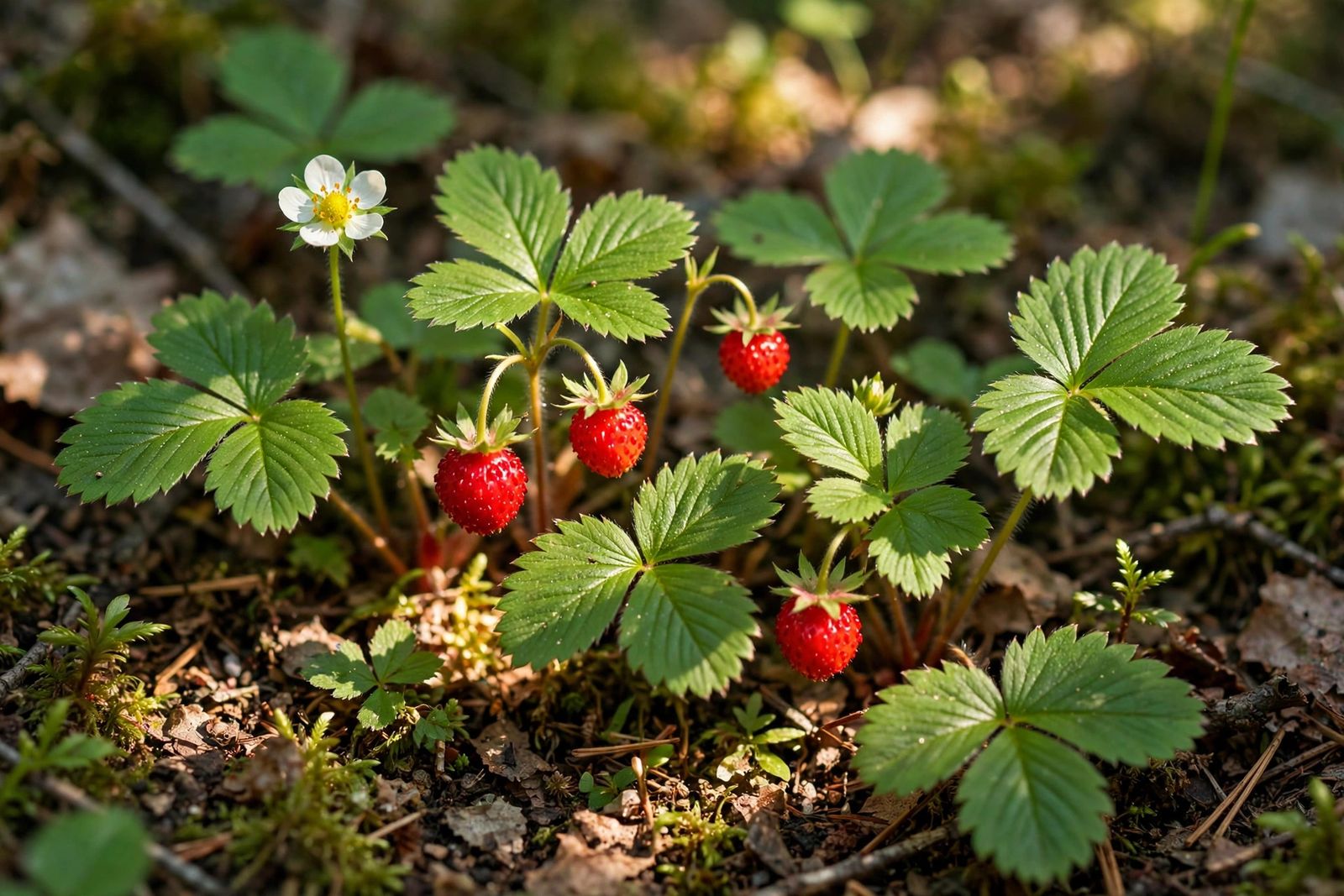
The leaves. Trifoliate — three toothed leaflets per leaf, the classic strawberry shape. In F. virginiana there is a fine botanical detail worth learning: the centre leaflet’s terminal tooth — the tooth at the very tip — is narrower and shorter than the teeth beside it. It’s a subtle mark, a supporting one, and a nice thing to show a kid with a hand lens. The flower will settle the identity long before you need it.
The flowers. White, sometimes blushed faintly pink, five rounded petals around a yellow centre, opening in May. Memorize this and the lookalike problem mostly solves itself: a strawberry flower is never yellow.
The fruit. It hangs DOWN on its stalk, typically tucked beneath the leaves, which is why strawberry pickers lift foliage as they go. The surface is studded with achenes — the true seeds — and in a real strawberry those achenes sit recessed in shallow pits, so the berry feels mostly smooth. Ripe colour is full, deep red, and the giveaway at arm’s length is scent: a ripe patch smells like jam. The flavour of even one berry is wildly out of proportion to its size.
Season and habitat
Flowers open in May; fruit follows in June and runs into July, earlier in warm southern sites, later in the north and at elevation. The season at any single patch is short — check promising spots weekly from the first June heat.
Wild strawberry likes open woods, trail and path edges, meadow margins, banks, clearings and the sunny sides of old fields — places with light but some shelter, from coast to coast across Canada. F. vesca keeps to shadier woodland; F. virginiana takes the open ground. A patch often announces itself by leaf long before fruit: learn the trifoliate shape in May and you’ll be standing in the right place in June.
Harvest and preparation
Pick fully red berries — wild strawberries don’t ripen further once picked, and a white-shouldered berry will disappoint you. Pinch the stem rather than pulling the fruit, lift leaves as you move, and pick into a shallow container where the berries won’t crush each other. Expect to eat as many as you save. That is not a failure of discipline; it is the traditional method.
There is rarely enough for cooking, and there doesn’t need to be: these are an eat-them-standing-up food, or a small handful scattered over cream or ice cream for people you like very much. On the rare bonanza year, a small pot of wild strawberry jam is one of the great preserves. Follow the first-taste rule as always — a small portion first — and wash what you bring home, particularly from any patch near paths or dog traffic.
Take gently and leave most. A strawberry patch is a perennial colony, feeding pollinators in May and birds, mice and bears in June, and it spreads by those runners you’re kneeling beside. Pick from the edges of a big patch rather than trampling its centre, and never dig plants up — a patch removed is a decade of berries gone.
Where you may pick it
Strawberry patches on your own ground, or on private land with the owner’s clear permission, are straightforward. On public land the answer depends on the designation under your knees — most parks prohibit removing plants and fruit, and other lands vary — so confirm your exact spot first in Is It Legal to Forage in Canada? and the Where Can I Pick? checker. The patches are patient; they’ll hold while you check.
Questions
How can you tell a true wild strawberry from mock strawberry?
By the flower: a true strawberry's flowers are always white, or the palest pink — never yellow. Mock strawberry blooms yellow, its fruit faces up toward the sky, and its red seeds sit on top of the surface. A true strawberry hangs down under its leaves, with pale seeds set in shallow pits.
When do wild strawberries ripen in Canada?
Flowers open in May, and fruit runs June into July, across Canada — open woods, trail edges, meadows, banks and clearings.
Is mock strawberry poisonous?
It is not considered poisonous, but it is not food: the fruit is dry and bland, and the lawns and ornamental beds it colonizes are frequently sprayed. Treat it as a lookalike to walk past, every time.