Dandelion
☠ Poisonous lookalikes — know these first
Before any of the good news: these are the plants this species gets confused with, and the exact marks that separate them. Learn these first.
Cat's ear (Hypochaeris radicata)
Cat's ear sends up branched stems carrying several smaller flowers, with small leaves growing right on the stem, and its stem is solid rather than hollow. A true dandelion never branches and never carries a leaf on its flower stem — one stem, one flower, nothing in between.
Risk: Low. This is mostly a culinary disappointment rather than a danger, but the rule stands: if the stem branches, it is not a dandelion, and it does not go in the basket on a guess.
Hawkweeds (Hieracium / Pilosella spp.)
Hawkweeds grow leafy, branched stems, often with a hairy or bristly feel, and open clusters of smaller yellow flowers. A dandelion's stem is completely bare and smooth, with a single large flower at the top.
Risk: Low, but they fail the dandelion test on sight: leaves on the stem and many small flowers mean a different plant entirely.
Sow thistle (Sonchus spp.)
Sow thistles grow tall — often waist height or more — with leaves clasping and climbing the stem all the way up. A dandelion never rises above ankle height and keeps every leaf in a flat rosette at the ground.
Risk: Low as a mix-up once the height and clasping leaves are noticed. A plant with leaves marching up a tall stem is not a dandelion, full stop.
If you learn one wild edible in Canada, learn this one — and learn it properly. The dandelion is everywhere, it’s genuinely good eating, and its identification is as close to foolproof as foraging gets, provided you check every mark and not just the cheery yellow flower. Half the yellow composites in a Canadian meadow are something else. The dandelion is the one that passes the full test below.
Identification
Work through the whole list, not your favourite item on it. A dandelion confirms itself five separate ways:
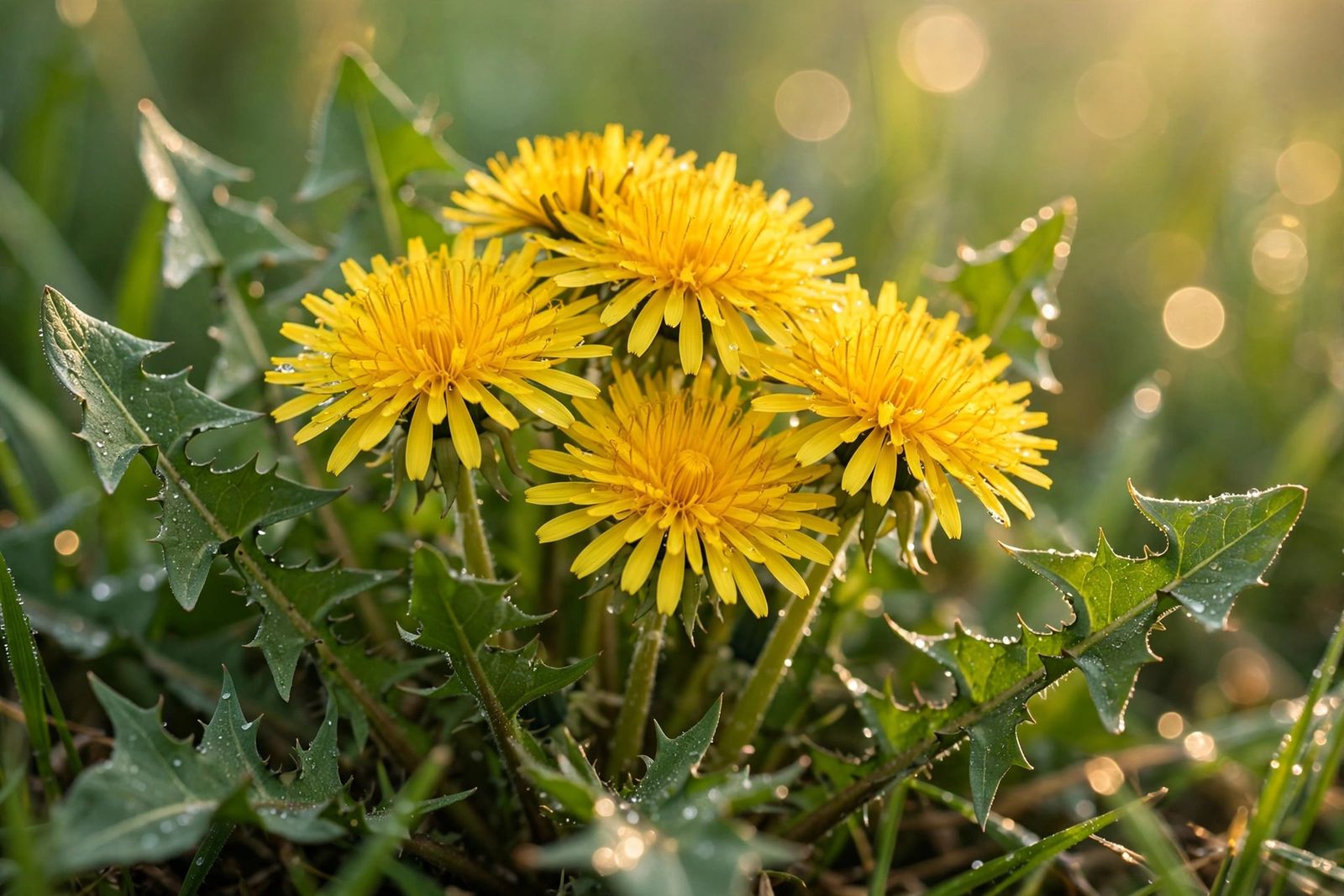
One flower per stem. Each flower stalk carries exactly one flower — never two, never a cluster. If the stalk branches, it is not a dandelion.
The stem is hollow, bare and unbranched. Snap one and look: the stalk is a smooth, leafless tube with no branches, no hairs worth mentioning and no leaves anywhere along its length. Everything leafy stays at the ground.
Leaves live only in a basal rosette. All the leaves spread flat from a single crown at soil level. They are deeply and sharply toothed — the teeth point backward toward the base, which is where the plant gets its name: dent-de-lion, lion’s tooth. No leaf ever grows on the flower stem.
Milky latex. Break a stem or tear a leaf and a white, milky sap wells up immediately. It’s harmless, bitter, and a reliable supporting mark.
The flower and the clock. The flower is a dense composite head of many tiny yellow strap-shaped florets — not a simple five-petal bloom. After flowering it closes, reopens as the familiar white puffball clock of parachute seeds, and the cycle repeats from spring to frost.
Below ground sits a single deep, unbranched taproot, which is why a dandelion pulled from a lawn comes up like a pale carrot — or snaps off and grows back. That stubbornness is the reason the plant is in every province and nearly every yard in the country.
Season and habitat
Dandelions flower from April into October in most of Canada, with the big flush in May and June and a smaller one in fall. For eating, timing matters more than presence. Leaves are at their best in early spring, before the flowers open, when they’re tender and only mildly bitter; by midsummer they’re sturdy and sharp. Roots are the fall harvest — sweetest after the plant has banked a season of growth, dug from October until the ground freezes. Flowers are picked as they open, through the spring flush.
Habitat is simple: open, sunny, disturbed ground. Lawns, meadows, garden edges, trailsides, gravel shoulders, vacant lots. The plant is a generalist and proud of it.
Harvest and preparation
The honest hazard with dandelions isn’t a lookalike — it’s the place. Never harvest from a lawn you don’t control: not a neighbour’s, not a boulevard, not a park verge, not a roadside ditch. Lawns get sprayed, roadsides collect exhaust and runoff, and popular green spaces collect dogs. Pick from your own untreated ground, or from clean meadow well away from traffic and spray drift, and wash everything thoroughly regardless.
Take leaves by cutting the rosette at the crown — the plant will often regrow, which is either a bonus or a warning depending on your feelings about lawns. Pick flower heads just opened, on a dry day, and use them promptly for jelly or fritters before they close. Dig roots with a narrow trowel and take the whole taproot.
Leaves are eaten raw young or cooked like any bitter green. Roots are scrubbed, chopped and roasted until dark for a caffeine-free coffee-style drink. Flowers go to jelly, wine and fritters. And follow the first-taste rule with any wild food, this one included: the first time you eat it, eat a small portion, wait, and see how you feel. A plant can be correctly identified and still disagree with you personally.
Where you may pick it
Your own untreated lawn is the classic dandelion patch, and private land with the owner’s clear permission works the same way. Beyond that, the rules change with the land under your feet — most parks prohibit removing plants of any kind, and this humble weed is no exception. Before picking anywhere that isn’t yours, read Is It Legal to Forage in Canada? and run your spot through the Where Can I Pick? checker. Legal first, basket second — even for a dandelion.
Questions
How can you tell a true dandelion?
One flower per stem, and the stem is hollow, bare and smooth, with milky latex when broken. A dandelion never branches and never carries a leaf on its flower stem — if the stem branches, it is not a dandelion.
When is dandelion in season in Canada?
April to October. The best leaves are in spring, and roots are dug in fall.
What plants are confused with dandelions?
Cat's ear, which sends up branched stems with several smaller flowers and a solid stem; hawkweeds, with leafy branched stems and clusters of smaller flowers; and sow thistle, which grows tall with leaves clasping the stem. All fail the one-flower, hollow-stem test.