Elderberry
☠ Poisonous lookalikes — know these first
Before any of the good news: these are the plants this species gets confused with, and the exact marks that separate them. Learn these first.
Pokeweed / pokeberry (Phytolacca americana)
Pokeweed berries hang in a single elongated raceme — one row of berries along a central stalk — on a vivid magenta-pink stem, and each berry has a dimpled, segmented top. Elderberry berries hang in broad FLAT-TOPPED clusters on green-to-reddish fine stems, never on a magenta stalk. Pokeweed also grows as a big soft herbaceous plant, not a woody shrub with compound leaves.
Risk: TOXIC — all parts, berries included. Causes severe cramping, vomiting and diarrhea. This is the confusion that matters on this page: if the cluster is a single dangling raceme on a pink stem, walk away.
Red elderberry (Sambucus racemosa)
A close cousin with bright RED berries in a more cone-shaped, upright cluster, ripening earlier in summer. Elderberry for the kitchen is purple-black and ripe in late summer, in flatter clusters.
Risk: Red elderberry fruit is not food — raw berries cause nausea and vomiting. The colour test is absolute: red means no.
Devil's walking stick (Aralia spinosa)
Black berries in large upright clusters on a small tree, found in southern Ontario — but the trunk and stems are fiercely spiny and the leaves are huge and twice-divided. Elderberry stems are smooth and pithy, never spined.
Risk: Berries are not considered edible. The spines make the confusion unlikely; check anyway.
Identification
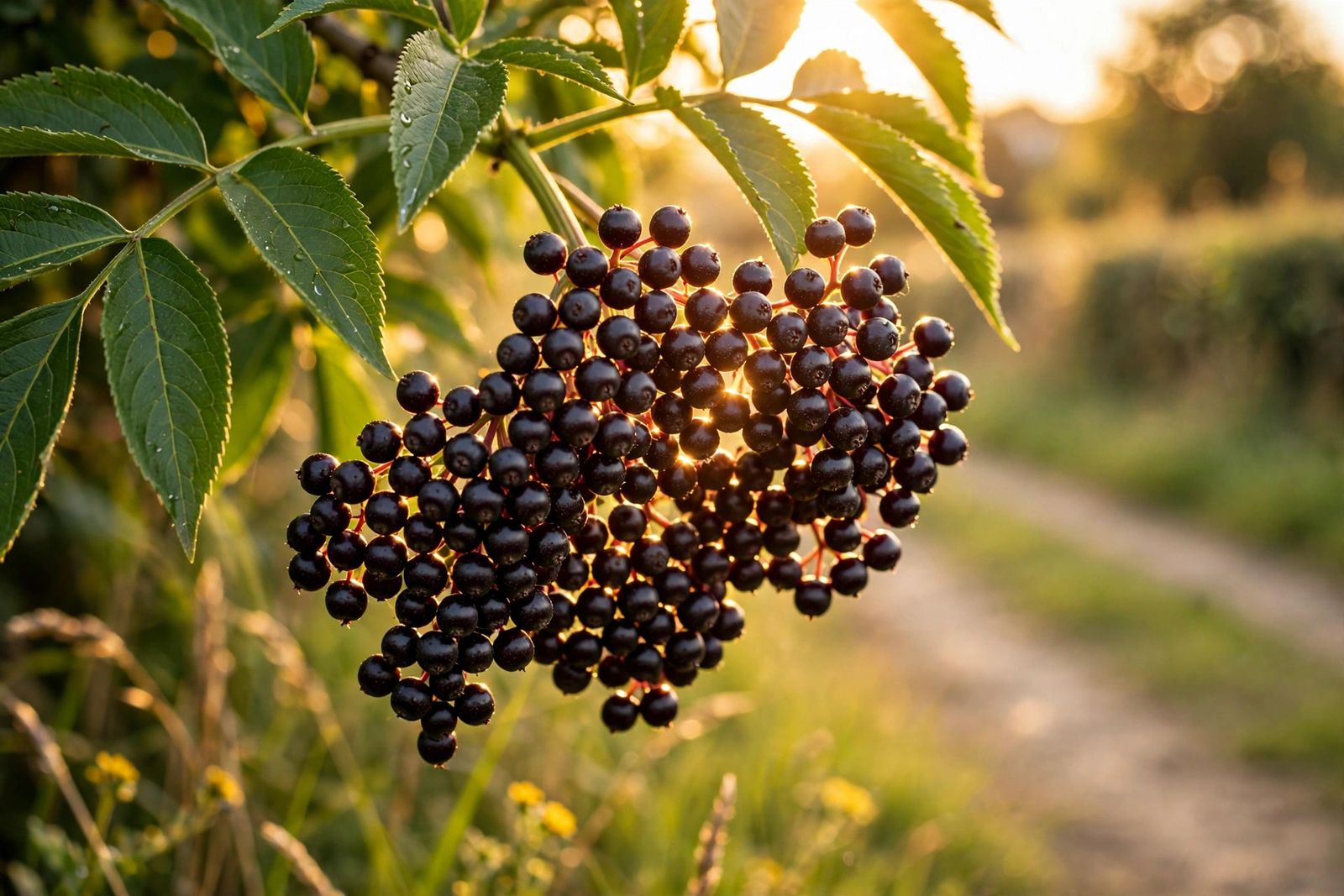
Elderberry is a multi-stemmed woody shrub, usually two to four metres tall, with arching canes whose stems are filled with soft white pith — snap a dead cane and the pith is a quiet confirmation. The leaves grow in opposite pairs along the stem and are compound: five to eleven sharply toothed leaflets per leaf.
In June the shrub covers itself in broad, flat-topped clusters of tiny creamy-white flowers, each cluster wider than a hand. By late August into September those clusters hang heavy with small round berries, five or six millimetres across, ripening green to red to a deep purple-black with a light bloom. In the east and centre the species is American elderberry, Sambucus canadensis; in the west it is blue elderberry, S. cerulea, whose berries often carry a whitish, almost blue bloom. The marks that carry the identification: opposite compound leaves, flat-topped clusters, purple-black berries, pithy smooth stems — all of them, together.
The cooking rule is part of the identification, not a footnote: elderberries are eaten cooked, always. Raw berries — and especially the seeds, stems, leaves and bark — contain cyanide-forming compounds, and a handful of raw berries can bring on nausea, cramps and diarrhea. Heat is what makes this food: simmered into syrup, jelly, and preserves, elderberry is a traditional Canadian late-summer staple.
Season and habitat
Berries ripen from mid-August through September, later at elevation and in the north. Elderberry loves moisture with sun: stream banks, ditch edges, wet meadow margins, fence lines, and the sunny edge of marshes and woods, from the Maritimes across the prairies to the BC interior and coast.
Harvest and preparation
Cut whole ripe clusters with scissors, leaving some for the birds that spread this plant, and strip the berries from the stems at home — the fine stems come off with a fork drawn through the cluster. Discard any red or green berries in the cluster (unripe fruit carries more of the compounds you are cooking to avoid), then cook the berries before anything else happens to them: a real simmer, ten to fifteen minutes, for syrups, jellies and pie fillings. Never eat them raw by the handful at the bush, and never juice them raw.
Where you may pick it
Elderberry’s wet-edge habitat is often on private farmland, in municipal ditches, or inside protected wetlands — three different rulebooks. The plant being common does not make the place public. Check whose land it is before the scissors come out, using Is It Legal to Forage in Canada? and the Where Can I Pick? checker — and never pick in a park where collecting is prohibited.
Questions
Can you eat elderberries raw?
No. Elderberries are eaten cooked, always. Raw berries — and especially the seeds, stems, leaves and bark — contain cyanide-forming compounds, and a handful of raw berries can bring on nausea, cramps and diarrhea.
How can you tell elderberry from pokeweed?
Elderberries hang in broad, flat-topped clusters on green-to-reddish fine stems, on a woody shrub with opposite compound leaves. Pokeweed berries hang in a single elongated raceme — one row along a central stalk — on a vivid magenta-pink stem. Pokeweed is toxic, all parts, berries included: if the cluster is a single dangling raceme on a pink stem, walk away.
When are elderberries ripe in Canada?
The berries ripen from mid-August through September, later at elevation and in the north. The flat-topped clusters of creamy-white flowers appear in June.