Ostrich Fern Fiddleheads
☠ Poisonous lookalikes — know these first
Before any of the good news: these are the plants this species gets confused with, and the exact marks that separate them. Learn these first.
Bracken fern (Pteridium aquilinum)
Bracken croziers rise singly on long stalks from creeping underground stems — never in a vase-shaped clump. The young stem is ROUND in cross-section with no groove, and carries no papery copper scales. Bracken's mature fronds are large, triangular and divided into threes at the top of tall individual stalks.
Risk: NEVER EAT — bracken contains ptaquiloside, a carcinogen, plus an enzyme that destroys vitamin B1. It is the most common fern in Canada and the one this page exists to keep out of your basket. No groove, no scales, no clump: no pick.
Cinnamon and interrupted fern croziers (Osmunda / Osmundastrum spp.)
These spring croziers are covered in pale WOOL — white, grey or rusty felt — not flat papery scales, and their stems lack the ostrich fern's deep U-shaped groove. Their clumps also lack the dark brown, plume-like fertile fronds that stand in an ostrich fern patch all winter.
Risk: Not the food this page covers. Woolly croziers are a stop sign: the only crozier on this site is the smooth, grooved, papery-scaled one, from a fern identified the summer before.
Identification
Fiddleheads are not a category of food. They are the spring croziers of exactly one fern — the ostrich fern — and this page’s method is backwards from how most people forage: you identify the fern in summer, when it is unmistakable, and only then return for its croziers the following spring.
The mature ostrich fern grows in a vase-shaped clump of arching sterile fronds, each one to a metre and a half, widest above the middle and tapering at both ends — the ostrich plume shape that gives the plant its name. In the centre stand the fertile fronds: stiff, dark brown, and plume-like in a different way, persisting upright through the winter. A patch still holding those dark plumes in April is a patch that identified itself.
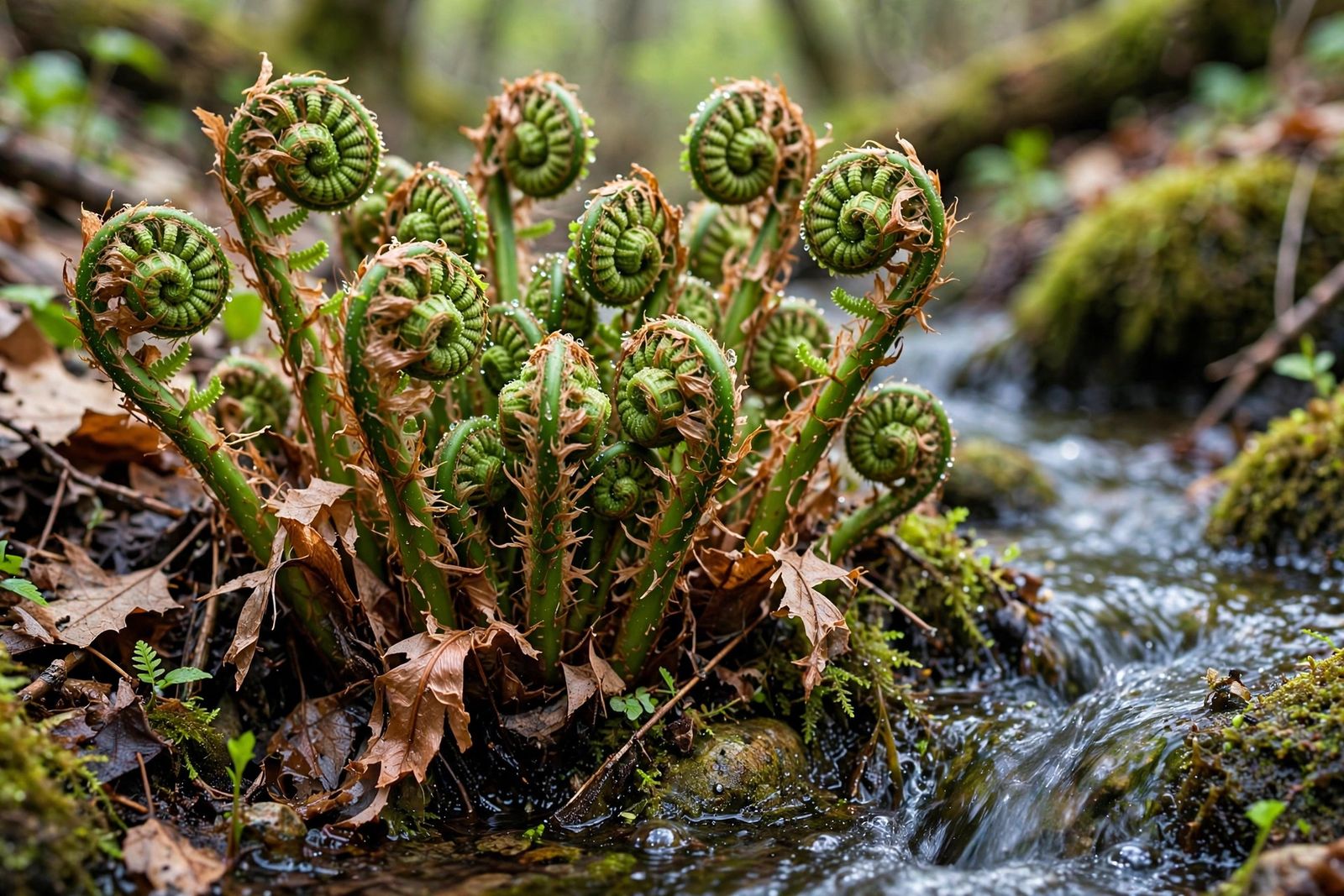
The spring crozier carries three marks, all required: a deep U-shaped groove running up the inside of the smooth green stem (slice one and look at the cross-section: a celery-like U); a coat of papery, copper-brown scales that rub off easily; and growth in the tight vase-shaped clump. Groove, scales, clump — if any one is missing, the basket stays empty.
Season and habitat
Croziers emerge for a few short weeks — April in the mildest eastern valleys, May across most of central Canada, into June in the north and at elevation. Ostrich fern grows in rich, moist deciduous woods, floodplains, and shaded stream and river banks, famously along New Brunswick’s rivers and across the east, thinning westward through Ontario and Manitoba.
Harvest and preparation
Take a few croziers per clump — never all — leaving the plant enough fronds to feed its roots, and cut rather than tear. Then Health Canada’s rules, which are not optional garnish: never eat fiddleheads raw. Remove as much of the brown husk as possible, wash in several changes of clean cold water, then boil a full 15 minutes or steam 10 to 12 minutes, and discard the cooking water. Only after that may they be sautéed, fried, or baked. Raw or undercooked fiddleheads have caused real outbreaks of illness in Canada — diarrhea, nausea, cramps, headaches within half a day — and no case has been associated with fiddleheads cooked this way. Home pressure-canning is not recommended; safe times have not been established. Freeze instead: clean, boil two minutes, chill, pack.
Where you may pick it
Riverbanks are a legal patchwork — Crown land, private woodlots, municipal parks, and protected areas can alternate along a single kilometre of shore, and some eastern municipalities regulate commercial picking. Verify the ground you are standing on with Is It Legal to Forage in Canada? and the Where Can I Pick? checker.
Questions
Which fern are fiddleheads?
Exactly one: the ostrich fern, Matteuccia struthiopteris. Fiddleheads are its spring croziers. This site's method is to identify the fern in summer, when it is unmistakable, and only then return for its croziers the following spring.
How do you identify an ostrich fern crozier?
Three marks, all required: a deep U-shaped groove running up the inside of the smooth green stem, a coat of papery, copper-brown scales that rub off easily, and growth in a tight vase-shaped clump. If any one is missing, the basket stays empty.
How must fiddleheads be cooked?
Never eat them raw. Health Canada's rules: remove as much of the brown husk as possible, wash in several changes of clean cold water, then boil a full 15 minutes or steam 10 to 12 minutes, and discard the cooking water. Only after that may they be sautéed, fried, or baked.
Why is bracken fern dangerous?
Bracken contains ptaquiloside, a carcinogen, plus an enzyme that destroys vitamin B1 — never eat it. Its croziers rise singly, with a round stem, no groove and no papery scales, never in a vase-shaped clump. No groove, no scales, no clump: no pick.