How to Get a Mushroom Identified in Canada (In Person, by People)
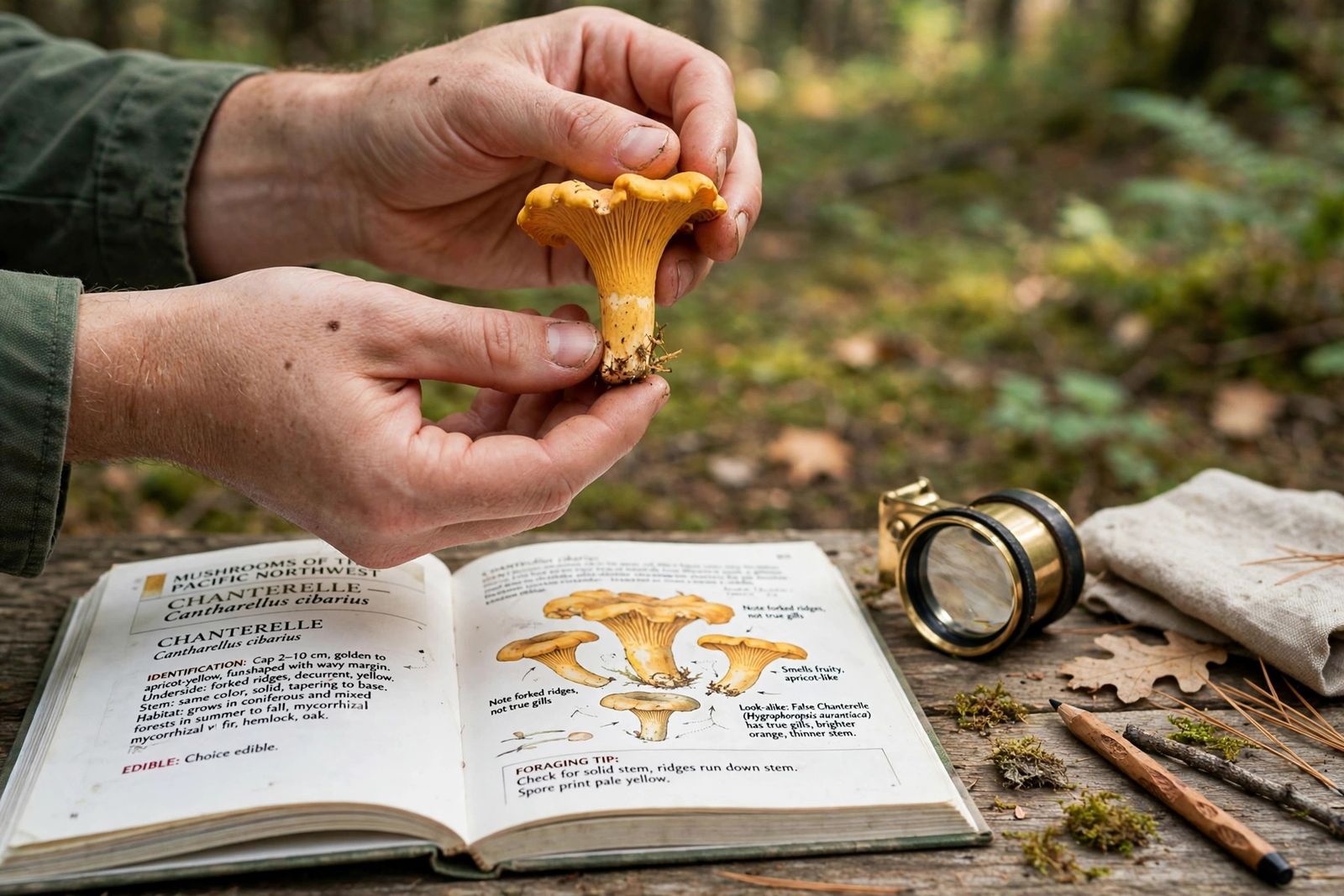
You found a mushroom. You think you know what it is. Now comes the step that actually matters — the one this whole site is organised around, and the reason we published our safety standard before a single species guide: getting that identification confirmed, in person, by a person who can be wrong to your face and correct themselves, holding your actual specimen.
This guide is the practical map. It is deliberately unglamorous. There is no app at the end of it.
The gold standard: a mycological society foray
Almost every province has a mycological society — a club of amateur and professional mushroom people who run organised forays through the season. The Alberta Mycological Society, the Vancouver Mycological Society, and the Mycological Society of Toronto are examples of the pattern; societies and clubs like them operate across the country. (We name them as examples of the route, not as endorsements of this site — the endorsement runs the other way. Their method is the standard we answer to.)
Here is what actually happens at a foray, because it is the opposite of a photo upload:
You walk a site with the group, collecting specimens whole — dug carefully so the base comes up intact. Finds go back to a table, where the day’s collection is spread out, sorted, and argued over. Experienced identifiers work through the specimens with keys, sometimes with microscopes, checking the features that decide an identification: cap, gills or pores, stem, base, habitat, and spore print. Specimens get labelled. Difficult ones get slowed down for. Some get named only to genus, and everyone at the table treats that as a fine and honest result.
Many societies also run identification nights or meetings where members bring in finds from their own walks. That table — a real specimen, a real expert, a real conversation — is what a trustworthy identification looks like. If you are going to eat wild mushrooms in Canada, a society foray is where your education should start, and it is genuinely enjoyable: these are people who love exactly the thing you are learning to love.
How to document a find so an expert can work with it
Identifiers can only work with what you bring them. The Alberta Mycological Society’s published guidance on asking its mycologists for an identification is the best etiquette we know, and it is worth following even before your first foray:
- One species per request, one species per container. Mixed baskets create confusion about which mushroom is being discussed — and confusion is the enemy.
- Take a spore print, and bring its colour. The Society calls spore colour one of the most critical identification features of a gilled mushroom. Cut the stem, set the cap gills-down on paper, cover it with a bowl, and wait three to four hours.
- Photograph the underside. Gills, pores, teeth — the underside carries decisive information a top-down photo never shows.
- Cut one specimen through the cap and down the stem. How the gills attach to the stem is a critical feature, and a cross-section reveals flesh, hollowing, and colour changes.
- Include the base. Dig the mushroom up whole. Some of the most dangerous mushrooms in Canada announce themselves at the base — a structure left in the ground is evidence thrown away.
- Note the smell, and any bruising or colour change in the flesh.
- Record where it was growing. On wood or on the ground? In a lawn or deep forest? And which trees were nearby — many mushrooms are faithful to particular tree partners.
And the Society’s closing rule, which we adopt as our own: if you are not 100% certain what you picked, do not eat it.
What poison centres do — and do not do
Every province has a poison centre, and every forager should know theirs exists. But be clear about the role: poison centres are for after something has been eaten, not for clearing a mushroom beforehand.
The Ontario Poison Centre says it directly: the poison centre does not provide mushroom identification. Their morel-season advisory makes the surrounding points too — even mushrooms generally considered safe should be fully cooked, cooking does not destroy the toxins of most poisonous mushrooms, only mushrooms identified by someone with expertise should be eaten, and if you are unsure of an identification, do not eat it.
If someone does eat a wild mushroom and develops symptoms, that is the moment to call: in Ontario, 1-800-268-9017; elsewhere, your provincial poison centre; in an emergency, 911. Keep an uncooked sample of what was eaten in the fridge — Public Health Ontario’s guidance and the poison centres agree on this — along with photos of the mushroom and where it grew. That sample can decide the treatment.
University extension and herbaria
Universities are the quieter route, and a real one. Extension services and university herbaria employ people whose work is identifying organisms properly, and public health and university experts are the authorities behind documents like Public Health Ontario’s evidence brief on foraged mushroom consumption — the brief that records why this matters: a single mushroom can carry enough toxin to kill, and Ontario’s destroying angel alone accounts for the majority of the province’s amatoxin deaths. If a society foray is the classroom, the university herbarium is the reference library behind it. For an unusual find, a specimen that stumps the local table, this is where it can end up.
iNaturalist and apps: learning tools, honestly labelled
iNaturalist is wonderful — for learning. Uploading observations, seeing what experienced observers make of them, watching a species’ range and season fill in across Canada: all of that builds real knowledge, and we encourage it.
But draw the line where the evidence draws it. An app agreement is not an identification. Studies of photo-identification tools find their accuracy on toxic species too low to bet a liver on, and Public Health Ontario marks even its own expert-selected photographs of poisonous mushrooms as not intended for use in identification. Treat every app result and community suggestion as a hypothesis to take to a person — never as permission to eat.
What we do — and what we will never do
Wild Forage Canada’s part in this system is the homework before the foray: the marks, the lookalikes, the seasons, and the legal map — including where picking is actually allowed, which is its own maze. What we do not do is identify anything from a photograph. Not by email, not by form, not ever; our contact page says so plainly. It is not that we are being difficult. It is that a photograph is not a specimen, and we would rather disappoint you than bury you.
Found something interesting? Wonderful. Dig it up whole, print its spores, note the trees — and take it to the people. That is not the cautious version of mushroom identification. In Canada, that is simply what identification is.
Questions
Can I send a photo to a poison centre to identify a mushroom I found?
No. The Ontario Poison Centre states plainly that it does not provide mushroom identification. Poison centres are an emergency and treatment resource: if someone has eaten a mushroom and becomes ill, call them — in Ontario, 1-800-268-9017 — and keep a sample and photos of what was eaten. For identification before eating, the route is a mycological society or an experienced local identifier.
Is an identification app or iNaturalist confirmation enough to eat a mushroom?
No. Apps and community identifications are learning tools, not identifications you should eat on. An app's agreement, or a crowd's, is not a person holding your specimen, checking a spore print, and standing behind the call. Use them to learn and to narrow things down — then confirm in person with someone experienced before anything is eaten.
What should I bring to a mycological society foray or ID night?
Whole specimens, dug up carefully so the base comes with them — never cut at ground level. Bring one species per container, note where it was growing and what trees were nearby, and if you can, bring a spore print: cap down on paper, covered, for a few hours. The Alberta Mycological Society's guidance is the model: underside photos, a cut through cap and stem, the base intact, smells and bruising noted.